

Jones Fiduciary Wealth Management
Fee-only · Fiduciary · CFS, CFP®
Your fee-only fiduciary wealth advisor for the sale of your business, the sale of your property, or the last day of your career, when the tax mitigation strategy matters as much as the portfolio decision.
We work with founders, landlords, and executives facing a sale, a retirement date, or both inside the same twelve months.
Fee-only means one set of interests: we build the tax strategy, coordinate with your CPA and attorney, then build the portfolio that replaces the income you're walking away from.
Who We Serve
Three moments end up on my calendar.
The Sale of a Business
The Offer Is Real. So Is the Deadline.
The founder with a real offer on the table, and a tax bill attached to it that nobody has planned for yet.
The Sale of a Property
You'd Sell It. The Gain Is What Stops You.
The owner who's done with the building, and has run the numbers on what leaving it costs.
The Last Day of a Career
The Paycheck Stops. The Tax Bill Doesn't.
The executive retiring on accounts that have never been taxed, in the years when how they get taxed is still a choice.
The window
Every one of these moments comes with a tax deadline.
The best time to plan is before the sale or the last paycheck, while every option is still open. The tax code rewards planning ahead.
After the date isn't hopeless. Some options close, others stay open for months, and knowing which is which is most of the job. Here's what to watch for.
Selling a business
The letter of intent
How the deal is structured, and how the price is split across what you're selling, gets negotiated there. Once it's signed, much of that's set, so this is the best time to plan. If the sale already closed, there can still be options for the gain, but the clock is running.
Selling a property
45 days, for one route
Rolling the proceeds into another property means naming it within 45 days of closing, a window set by statute. Miss it and you've lost one of your options, not all of them. Under current rules, other routes for the capital gain portion can stay open for up to 180 days after the sale.
Retiring
The years before RMDs
Almost everything you saved has never been taxed. The years between your last paycheck and required minimum distributions are when you have the most say over how it gets taxed, often through Roth conversions spread over several years. Medicare looks back two years at your income, so each year's choices show up later too.
Leaving with a pension or company stock
Before you sign the paperwork
Pension payout choices are usually permanent once you make them. And if your retirement plan holds your employer's stock, rolling everything into an IRA by default can cost you a special tax election on that stock.
None of these are judgment calls. They're dates, and they pass.

How this works
Tax strategy first. The portfolio follows.
There's no fixed clock on this. The tax strategy moves at the pace of your situation and your CPA, and the portfolio gets built once the tax picture is clear.
Build the Tax Strategy
We start with what the transition does to your tax picture, and which choices are still open on the day we're talking.
Coordinate Your CPA and Your Attorney
The tax work, the legal work, and the investment work stop happening in three rooms that never talk to each other.
Build the Portfolio That Replaces the Income
The business paid you. The building paid you. The paycheck paid you. Now the portfolio has to, and that's a different job from growing a balance.
Who you'd be working with
I spent 19 years and 335 days on the other side of this.
I spent nearly two decades on the legacy side of the industry. I left one month short of the twenty-year mark, the one that comes with a wristwatch. People ask if I regret it. All I missed was the expensive watch.
I left because the programs I was handed came with layers and layers of fees, and there was no version without them. I couldn't take those fees off my clients' accounts, and I didn't believe what they paid for was worth it.
I recommended those programs in good faith, because I'd been trained to believe there wasn't a better way. So when I tell you the legacy side of the industry substitutes convenient recommendations for correct ones, I'm not repeating a rumor.
I'm confessing.
For the record
- Contributing author, Real Life Financial Planning for Physicians
- Contributor to CNBC online

The answer
Retirement changes the rules on you. Here's what I build for it.
For your whole working life, a falling market was a sale, and you were the one shopping. Then you retire, and you're the one selling.
Volatility stops being an opportunity and becomes a threat, because selling into a dip turns a paper loss into a permanent one. Time stops being an ally too, since a bad stretch early on does damage that waiting won't undo.
That's sequence of returns risk, and it's the governing problem of retirement income. The conventional answer is still the 60/40, and at current yields it's structurally short on the income a retirement has to produce.
So I build toward a different design goal: minimize the need to sell assets during downturns.

To be clear about what this is and what it isn't. Minimizing the need to sell during a downturn is a design goal, not a guarantee. No portfolio structure removes the risk of loss, and investing involves risk, including the possible loss of principal. Whether any of this is appropriate for you depends on your own circumstances. Nothing here is a recommendation or a prediction of any result.

The Fee Warranty
Financial advice at one fair fee. And a warranty on the fee.
I'm not going to tell you I'm confident in the plan. Everybody says that.
I'd rather put it in writing.
Nothing is what you pay in advisory fees if you're not completely satisfied in your first six months.
If you're not completely satisfied with our progress in your first six months:
- I stop charging you my fees immediately.
- I help you find a new advisor.
- I help with the transfer.
- I refund the advisory fees from your first six months.
Not prorated. Not credited toward next quarter. Refunded.
To be clear about what this is and what it isn't. The Fee Warranty covers the advisory fees you pay me. It is not a guarantee of investment performance, of any particular result, or against loss. Investing involves risk, including the possible loss of principal. Eligibility, the covered period, and the full terms are set out in the client agreement.
What's at stake
Nobody is too senior to get skimmed.
One of my favorite clients was the chief operating officer of a major bank's corporate banking group. As an employee, she was required to keep her retirement plan at that bank, on the discounted employee rate.
On top of that rate, they charged her an extra fee for a program with a polished name. What the program actually did was hire someone else to do the trading, and then charge her for that hire. She was a senior executive at the bank, and she was still paying twice.
If it can happen to her, the odds are good something similar is happening to you.
Side note: I'm not telling this to single out one bank. I'm telling it because if a fee like that can get past a senior banking executive, it's worth a close look at your own statement.

Here's the other side of it.
You should be able to name every fee you pay, and what you get for it.

The problem
Harvesting a loss in December isn't a tax plan.
On the legacy side of the industry, tax planning usually meant a short list: harvest a loss in December, maybe a backdoor Roth, maybe an annuity or a life insurance policy. I know that list well.
Harvesting a loss is a real tool, but it usually postpones the tax rather than removing it. Sell, rebuy something similar, and the gain you didn't pay this year tends to show up in a later one.
A municipal bond pays less interest and hands you the difference back as a tax break. And if you're holding bonds in a taxable account in the first place, munis are a bandage on something that needs a real fix.
If your tax advice is muni bonds and year-end loss harvesting, you don't have a tax plan. You have a placebo.
Deferring into a 401k doesn't help on its own, either. Pay the rate now, or pay the same rate later on a bigger number, and the math lands in the same place. Deferral only wins when something else changes too.
None of that list touches the tax on the business or building you'd like to sell, or on the retirement account that has never been taxed. That's where the real money is.
The book
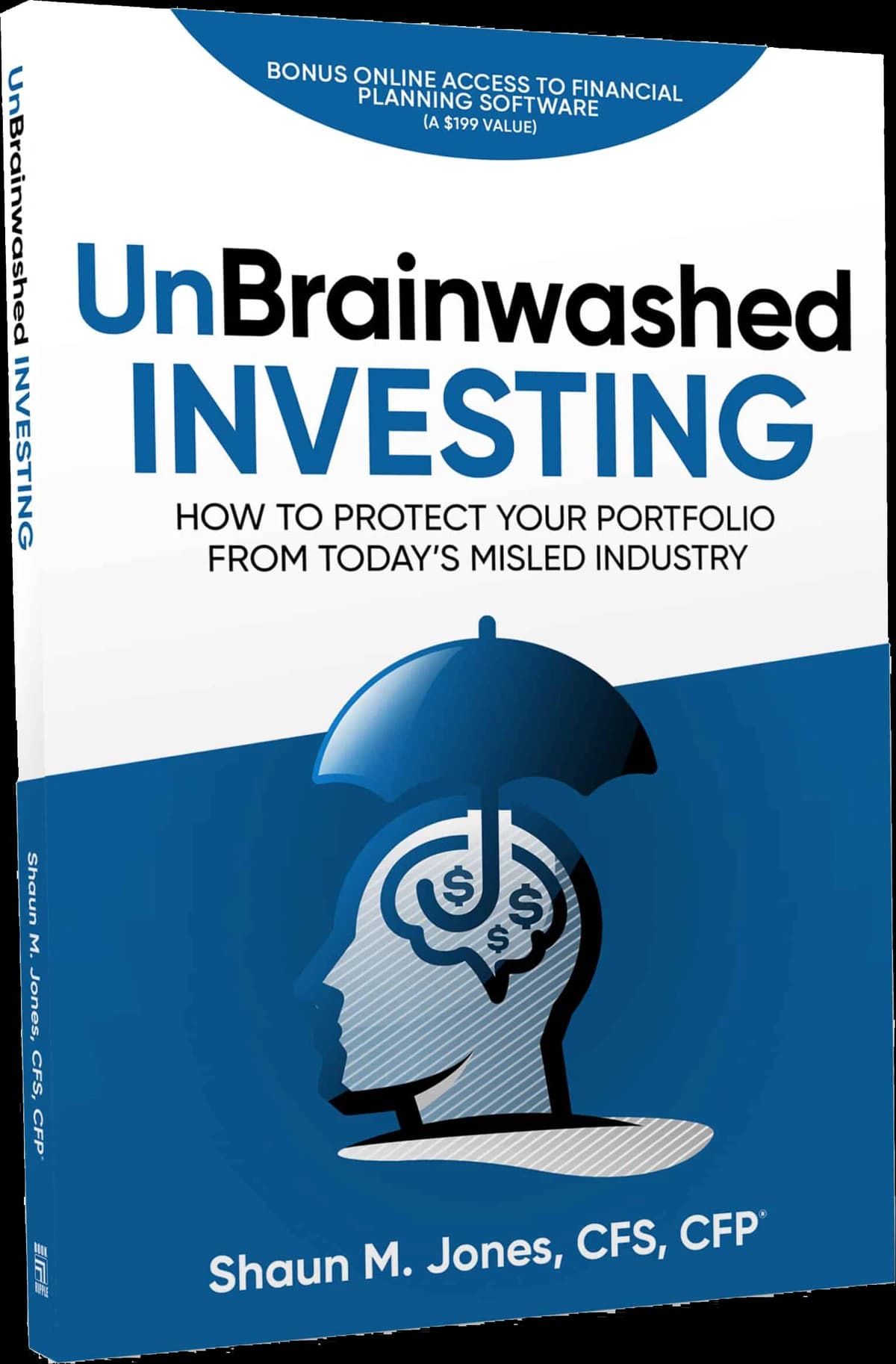
I wrote the book on the fees you can't find.
UnBrainwashed Investing: How to Protect Your Portfolio from Today's Misled Industry
Chapter 4 is the one about fees. I'll send it to you free, no strings.
Read it, then go ask your advisor about the ones you didn't know existed.
Inside Chapter 4
- Everything you need to know about fees and expenses
- Which expenses aren't included in a fund's internal expense ratio
- How to tell high fees from low fees, and advisable fees from reckless ones
Fair warning: I've since changed my mind about bonds, and the book leans on them. I'll tell you that story on the call.
The Resource Center
I show my work.
Everything on this page has a longer version: articles, podcast episodes, whitepapers, and the book, all in one searchable place.
All of it's free, and none of it asks you to talk to me first.

Article · 2 min read
The One Thing Most Advisors Hope You Never Ask
Not all financial advisors operate the same way.Some work on commissions, others are Fee-Only. What’s the difference? Commission-Based Advisors Fee-Only Advisors Here’s...
Sep 3, 2026 · Advisors & Fees

Article · 1 min read
When Rate of Return is Useless
There is ZERO point in getting excited about a good rate of return, if you don’t plan the taxes out.
Sep 1, 2026 · Taxes

Article · 2 min read
"Active” vs. “Passive” Investing
We believe in an combination: *Passive stock market investment (because let's be honest, you can't beat the stock market by playing the stock market) *Active, outside the stock market (investments like real estate, data centers, and energy production of the future)
Aug 27, 2026 · Investing

Article · 1 min read
I don’t want to lose a friend over this…”
This week I had a free consult with someone who has $3.5 million at a big-box firm. His advisor?A good friend....
Aug 20, 2026 · Advisors & Fees

Article · 1 min read
Taxes After 250 Years
The American Revolution was sparked by taxes. Farmers challenged the most powerful empire in the world—not over politics or land—but...
Aug 18, 2026 · Taxes

Article · 2 min read
AI is the Train and Data Centers are the Tracks
You’ve seen the headlines:Amazon. Microsoft. Meta.Laying off thousands… while pouring billions into AI. But here’s the truth:AI doesn’t run on...
Aug 13, 2026 · Investing
The hardest person to mislead is the one whounderstands their own money.
Questions
The things people actually ask.
What is a fee-only fiduciary?
A fee-only fiduciary is an advisor who's paid only by you. No commissions, no product revenue, no compensation from any third party. That's different from "fee-based," which sounds nearly identical but means the advisor charges you a fee and can still collect commissions from other parties. The distinction decides whose interests are sitting across the table from you.
It also cuts the other direction. Because I'm fee-only, when a commission-based product genuinely is the right tool, the commission goes to the client instead of to me. On one $3.7 million investment, that was $227,000 credited to my client rather than paid to my firm.
That was one client's situation, and it is not representative of what any other client should expect. Most of the time a commission-based product isn't the right tool. The amounts are usually far smaller, the arrangement only makes sense at certain account sizes, and none of it is a prediction of any result for you. I'm describing how I'm structured, not what you'd get.
One more thing worth knowing. In financial services, "fiduciary" means putting your interests before the advisor's own. In law it means treating the client as well as the lawyer would treat themselves. I like the lawyer's version better.
How are you paid, and what does it cost?
I'm paid one way: directly by you, as a percentage of the money I manage. Nobody else pays me. No commissions, no product revenue, no third party writing me a check for putting you in something.
What that costs depends on what you have and what you need, and you'll see the number in writing before you sign anything.
It also means good tax work usually shrinks my own fee, because my fee is calculated on the balance that work moves money out of. I'd rather that than the alternative.
I want to sell, and the tax bill is what's stopping me. What are my options?
You usually have more than one, and the right one depends on what you're selling, what else is on your return that year, and when you need the money. That's why the honest answer is that I'd have to look.
Most of the levers in the tax code work on timing: how the sale is structured, which year the gain lands in, and where the proceeds go next. Some of those choices have to be made before the sale. Others stay open for a while after it.
Here's the question worth taking to the advisor you already have. Ask them whether selling has to cost what they told you it costs, and what they'd want to see in order to answer.
Should I talk to you before I sell, or after?
Before, if you can. Before the sale, the timing is still yours: how the deal is structured, what year the gain lands in, and what else happens on that year's return. That's when you have the most options.
If you've already sold, call anyway, and soon. Under current rules, some options for the capital gain portion stay open for up to 180 days after a sale, and there's still a return to read and years ahead to plan.
I'd rather talk to somebody with an offer on the table than somebody whose wire cleared last week. But I'd much rather talk to the second person than not at all.
I'm retiring. What should I be doing before my last paycheck?
Start with the fact most people don't think about: almost everything you saved in your retirement accounts has never been taxed. The day you start taking it out, it gets taxed, and how much depends on choices you still control.
The years between your last paycheck and required minimum distributions are when you have the most say over your own tax bracket. That's usually where Roth conversions happen, spread over several years rather than crammed into one. Medicare looks back two years at your income, so each year's choices show up later too.
If you have a pension, the way you take it is usually a one-time choice. And if your retirement plan holds your employer's stock, rolling everything into an IRA by default can cost you a special tax election on that stock.
None of that is a recommendation for your situation, and what applies to you depends on your own circumstances. It's why I'd rather talk to somebody a year early than a year late.
Isn't tax-loss harvesting tax planning?
It's a real tool, and it's a much smaller one than it's sold as.
Here's the math. You buy a position, it drops, your advisor sells it and immediately buys something similar to stay invested. Later the position recovers and you sell, and the gain you didn't pay earlier usually shows up then. Harvesting usually postpones the tax rather than removing it.
There is one legitimate benefit, and it's a good one: harvested losses give you the flexibility to rebalance a portfolio without triggering a tax event. That's genuinely useful. It just isn't the same thing as a tax plan.
What does the Investment and Tax Audit actually find?
The Investment and Tax Audit finds the gap between what you're paying and what you're getting: your all-in fees, how your assets are actually allocated, and the tax drag on your wealth across your whole lifetime rather than just last year.
Traditional tax planning looks backward at the year that already closed and asks how to legally owe the least on it. The audit looks forward. It examines tax-loss harvesting, investment allocation optimization, tax return matching, variable annuities, Roth conversions, charitable giving, and more.
Over a lifetime, taxes can be one of the largest costs an investor carries, which is why the audit looks forward and not just at last year.
Do you replace my CPA?
No. I work alongside your CPA rather than instead of them. They file the return. I read it.
Reading it is the part that tends to go missing. Ask the advisor you already have whether they've ever asked to see your tax return. The answer tells you how much tax planning is actually happening.
If you don't have a CPA and you need one, I'll point you toward somebody good.
Where does my money actually sit?
At a major independent custodian, in an account in your own name. Not in an account with my name on it. Yours.
I never hold your money. I advise on it. You can look at it any day you want, and if you ever decide to leave, it's already yours to take.
That distinction sounds small until the day you want to ask a hard question, and the person answering has nothing to hold over you.
Who is this NOT for?
This isn't for you if you want somebody picking hot stocks and calling it a strategy. It also isn't for you if you're comfortable keeping 40% of your money in bonds because that's what the standard chart says.
If what you want is a quarterly hot idea, a lot of movement, and the feeling that somebody is always doing something, we're going to frustrate each other.
And if you want somebody to tell you your current plan is great, I'm not the person to say it unless it's true. I'd rather lose you here than mislead you in a meeting.
What should I bring to the first call?
Nothing, if you don't want to. There's no prep required and nothing to sign.
If you'd like the call to be useful faster, bring your statements, your account agreements, and your last couple of tax returns. Whatever you can gather is enough to start.
And if all you have is a nagging sense that something is off, that's enough too.

Start With a Score, Not a Sales Call
Score the advice you're getting now.
Answer a few questions about your advisor, your fees, and your last tax conversation.
You'll get a score, and you'll know exactly what to ask about next.
Knowing is quieter than wondering.
No charge. You keep the results. And you don't have to move a dollar to talk to me.

Jones Fiduciary Wealth Management
Fee-only · Fiduciary · CFS, CFP®
Ask somebody.It doesn't have to be me.
Schedule a Curiosity Call and bring the question that's been sitting in the back of your head. There's no charge and there's nothing to sign.
Or don't call me at all.
Pull up your last statement, call the advisor you already have, and ask them three things. Honest answers hold still when you push on them.
Three questions
- What's my all-in fee, including everything charged inside the funds?
- Is anyone other than me paying you?
- Have you ever asked to see my tax return?
If you like the answers, you're in good hands, and I'm genuinely glad.
If you don't, my calendar is open.
Ask your advisor what they charge you. Just ask them outright.
The Paper Trail
Four reasons to believe me, and not one of them is a testimonial.
Over a lifetime, taxes dwarf fees, inflation, and most of what the market does to you. That's the thing I build around.
Integrity
Most of the tax planning I recommend makes my own fee smaller. A large pre-tax IRA is a tax bill nobody has measured yet, and dealing with it properly moves money out of the balance my fee is calculated on. I'd rather be paid less than leave that tax bill unmeasured.
Coordination
I work alongside your CPA, not instead of them. They file the return. I read it, and we plan the next one together. Ask the advisor you already have when they last asked to see your tax return.
Risk reversal
There's a written warranty on my fee, and it's two sections down this page. It covers fees, not investment results. I'd rather carry the risk of being wrong than ask you to. Go read the terms, then ask the advisor you already have what happens if you're unhappy six months from now.
Outcome
Peace of mind is the product. The portfolio is only how it gets delivered. What I'm working toward isn't a better number on a statement, it's you not running the are-we-going-to-be-okay loop at two in the morning. That's harder to put in a brochure, and it's the whole point of the work.